If you have ADHD and take medication, you have probably asked yourself some version of this question at least once: "Is this actually working today — or am I just hoping it is?"
Most people never find a clear answer. They rely on gut feeling, guess-work, or the vague memory of a "good day" versus a "bad day." And that is a problem — because your ADHD medication does not work the same way every single day.
The good news? There is a straightforward daily tracking method that cuts through the guesswork. And it takes less than 30 seconds.
Why Tracking Your ADHD Medication Actually Matters
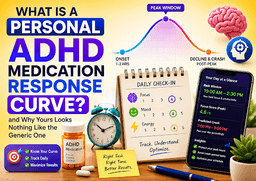
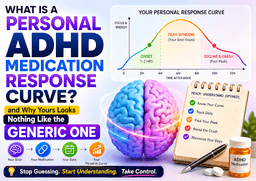
ADHD stimulant medications — Adderall, Vyvanse, Concerta, Ritalin, and others — follow a predictable pharmacokinetic curve. They rise to a peak, hold for a window, and fall off. But here is the part that surprises most people: that curve looks different for every individual.
Your metabolism speed, sleep quality, food timing, stress levels, and even hydration affect when your medication peaks and when it crashes. A dose that gave you 8 hours of focus last Tuesday might give you 5 hours on Thursday — and you would have no way of knowing unless you were tracking.
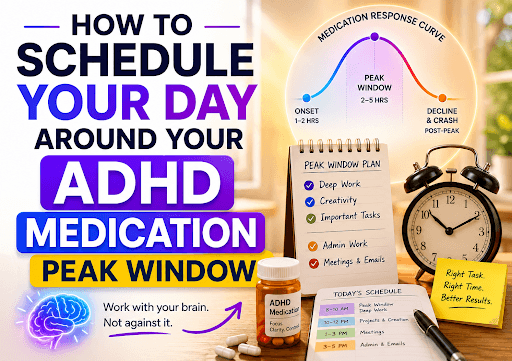
Without tracking, you are essentially flying blind. You schedule important meetings, deep work sessions, and creative tasks based on what your medication is supposed to do — not what it is actually doing for your specific body on that specific day.
What Most People Try — And Why It Fails
Journalling
The classic advice. Write down how you feel each day. The problem? ADHD makes sustained journalling nearly impossible. Most people manage 3–5 days before the habit collapses.
Hourly Self-Rating Spreadsheets
Some highly motivated people build elaborate Excel sheets to track their focus hour by hour. These work beautifully — for about two weeks. Then ADHD happens.
Memory and Intuition
"I think my medication peaks around 10am." This is the most common approach and the least reliable. Human memory is notoriously poor at tracking patterns over time, especially patterns that shift subtly day to day.
The Method That Actually Works: Three Check-Ins, Ten Seconds Each
The reason most tracking systems fail for people with ADHD is friction. The more steps required, the faster the habit dies.
The most effective approach strips tracking down to its minimum viable form:
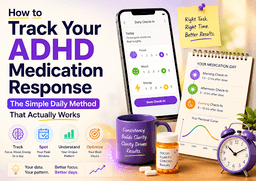
Three times a day — at fixed times — rate three things on a 1–5 scale:
- Focus (1 = can't concentrate at all, 5 = sharp and locked in)
- Mood (1 = flat and irritable, 5 = positive and motivated)
- Energy (1 = depleted, 5 = clear and alert)
That is nine numbers per day. Each check-in takes under 10 seconds. And over 7–14 days, those nine numbers per day build something genuinely useful: a pattern.
When to Check In — Timing Your Three Daily Logs
The timing of your check-ins matters as much as doing them at all. The goal is to capture data at three distinct points in your medication arc:
- Morning check-in (approximately 1.5–2 hours after your dose): Captures your onset and early peak phase
- Afternoon check-in (approximately 5–6 hours after your dose): Captures your mid-day window — peak or beginning decline
- Evening check-in (approximately 8–10 hours after your dose): Captures your post-medication baseline
These three data points, collected consistently, give you a daily snapshot of your full medication arc.
What Patterns Start to Emerge After 7 Days
After a week of consistent check-ins, something interesting happens. You start to see your personal pattern emerge:
- Your actual peak time — which may be earlier or later than the generic guidance suggests
- Your actual window duration — which is almost certainly different from the stated 8 or 10 hours
- Your crash signature — the specific combination of focus, mood, and energy drops that signals your window is closing
- Your variable days — days where your pattern shifts due to sleep, food, or stress
This information is not available in any pharmacology textbook. It can only come from your own data.
The Difference Between Tracking and Understanding
Collecting data is only the first step. The real value comes when that data is analysed — when the numbers are connected to your dose timing and turned into something actionable.
This is where most manual tracking systems fall short. A spreadsheet shows you numbers. What you actually need to know is: "Given today's dose time and my personal response history, when will my peak open — and when should I expect to crash?"
That is the question daily tracking is ultimately trying to answer.
Key Takeaways
- ADHD medication response varies significantly from person to person and day to day
- Most manual tracking systems fail due to friction — simplicity is essential
- Three 10-second check-ins per day (focus, mood, energy) is the minimum viable tracking habit
- After 7 days of consistent check-ins, personal patterns begin to emerge clearly
- Tracking alone is not enough — data needs to be connected to dose timing to become actionable
Frequently Asked Questions
How long does it take to see a pattern from daily check-ins?
Most people begin to notice a consistent pattern after 7–10 days of regular check-ins. The pattern becomes more reliable and personalised with each additional day of data.
Does the time of day I take my medication affect the check-in results?
Yes — significantly. Even a 30–45 minute shift in your dose time can move your peak window by the same amount. This is why consistent dose timing is as important as the check-ins themselves.
What if I forget a check-in?
Missing an occasional check-in is normal and does not invalidate your data. Consistent effort over time is far more valuable than perfect daily completion. The pattern will still emerge.
Can I track non-stimulant medications like Strattera?
Yes, though Strattera (atomoxetine) works differently — it builds steadily over weeks rather than producing a daily peak-and-trough arc. Check-ins are still valuable for tracking mood and energy trends over time.
Is there an easier way to do this tracking without a spreadsheet?
Yes. Apps like Peakly are designed specifically to automate this process — delivering check-in reminders at your configured times and turning the raw ratings into a visual response curve automatically.