Most productivity advice for people with ADHD focuses on systems, habits, and mindset. Very little of it addresses the most practical variable of all: when in your day your brain is actually capable of the work being asked of it.
If you take ADHD medication, you have a biological window each day when your cognitive capacity is at its highest. What you do with that window — and whether you protect it or waste it — has more impact on your daily output than almost any other single variable.
Here is how to build a schedule that actually works with your medication rather than against it.
Why ADHD Scheduling Advice Usually Fails
Standard time management advice — time blocking, the Pomodoro technique, morning routines — is built on the assumption that your cognitive capacity is reasonably consistent throughout the day.
For people with ADHD who take medication, this assumption is completely wrong.
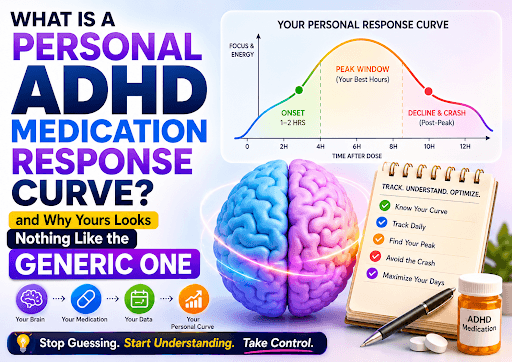
Your capacity is not evenly distributed across the day. It rises steeply during medication onset, peaks for a window of variable duration, then falls — sometimes sharply. Applying a fixed scheduling system across this variable arc produces predictable results: you end up doing deep work during your crash and administrative tasks during your peak, or vice versa, with no reliable way to know which is which.
The solution is not a better scheduling system. It is knowing your window.
The Three Zones of Your Medication Day
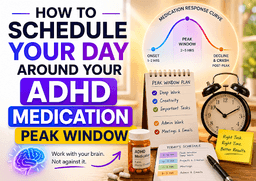
Once you understand your personal response curve, your day naturally divides into three functional zones:
Zone 1 — The Building Phase (Onset to Peak)
This is the 1–2 hour period after your dose during which your medication is being absorbed and your focus is rising but not yet at full capacity. Creative warm-up work, reviewing materials, light planning, and organisational tasks fit well here.
Zone 2 — The Peak Window (Your Most Valuable Hours)
This is the period of highest cognitive availability. Deep work — your most demanding intellectual, creative, or analytical tasks — belongs here. For most people this window lasts 2–5 hours depending on their personal curve. This time should be treated as protected.
Zone 3 — The Decline and Post-Medication Period
As the medication wears off, cognitive demand should decrease to match your available capacity. Administrative tasks, emails, scheduling, routine meetings, and low-stakes work belong in this zone. Attempting deep work here typically produces frustration and poor output.
What to Put in Each Zone
Zone 2 — Deep Work (Protect This)
- Complex writing, analysis, coding, design
- Client work requiring sustained concentration
- Learning new skills or concepts
- Creative problem-solving
- Any task where quality of thinking directly determines quality of output
Zone 1 — Warm-Up Work
- Reading through notes or materials from the previous day
- Light planning and prioritisation for the day ahead
- Responding to simple messages
- Organisational tasks that require attention but not deep thought
Zone 3 — Administrative Work
- Email processing and responses
- Scheduling and calendar management
- Routine meetings where presence matters more than sharp thinking
- Filing, organising, administrative follow-ups
- Low-stakes creative work or brainstorming
The Single Most Common Peak Window Mistake
The most consistent pattern among people with ADHD who track their medication: they waste their peak window.
Not intentionally. The peak window is also, for many people, the window of highest dopamine availability — which means it is also the window where distracting, dopamine-seeking behaviours (social media, YouTube, interesting tangential problems) feel most rewarding.
The result is predictable: the peak window opens, and instead of immediately starting the most important task, the person spends 45 minutes on Reddit or in an interesting but unplanned conversation. By the time they sit down to do real work, the window is narrowing.
The intervention is simple but requires preparation: know when your window opens before it opens, and have your most important task already queued up and ready to start. A focus window alert — a notification that tells you your peak is opening — is specifically valuable for this reason. It interrupts the default behaviour and creates a moment of intentional choice.
How to Build Your Peak-Aware Schedule in Practice
Step 1 — Establish your personal peak window times
Through 7–14 days of consistent check-ins, identify your typical peak start and end times. These become your protected deep work hours.
Step 2 — Pre-load your deep work task the night before
Each evening, identify the single most important task for tomorrow and set it as your default morning task. When your peak window opens, there is no decision to make.
Step 3 — Block your peak hours as non-negotiable
On your calendar, block your peak window as "Focus Block — unavailable." Decline meetings scheduled during this window where possible.
Step 4 — Prepare your environment before onset
Before your medication begins to act, set up your workspace, close distracting tabs, put your phone face-down, and open the document or tool you will be working in. Lower the activation energy for starting.
Step 5 — Schedule everything else around the window
Build the rest of your day around the protected peak. Meetings before onset or after the decline. Administrative work in Zone 3. Personal tasks in the evening.
Key Takeaways
- ADHD medication creates three distinct functional zones each day — building, peak, and decline
- Deep work should be concentrated in the peak window — the highest-value cognitive hours
- The most common peak window mistake is wasting it on dopamine-seeking distractions
- Pre-loading your most important task the night before removes the decision barrier when the window opens
- A focus window alert — a timely notification — is the most effective trigger for intentional peak window use
Frequently Asked Questions
What if my peak window falls at an inconvenient time — like early morning?
Your peak window timing is primarily determined by when you take your medication. If your natural peak falls at an inconvenient time, the most practical intervention is gradually adjusting your dose time — in consultation with your doctor — to shift the window to a more useful part of the day.
How do I handle days when my peak window is shorter than usual?
Shorter peak windows typically correlate with poor sleep, high stress, or late dose timing. On these days, ruthlessly prioritise — pick the single most important task for your shortened window and accept that less will get done. Avoid spreading a reduced window across multiple tasks.
Should I schedule meetings during my peak window?
Generally, no. Meetings require presence and communication but rarely require the deep cognitive output that the peak window is best suited for. Reserve meetings for Zone 1 or Zone 3 where possible.
What if I have two doses per day?
Two-dose regimens create two distinct functional arcs across the day. The morning dose arc typically produces the primary peak. The afternoon dose creates a secondary arc. Tracking both separately helps you understand each window's characteristics and schedule accordingly.
Does this scheduling approach work for non-stimulant ADHD medications?
Non-stimulants like Strattera do not produce a daily peak-and-trough arc. They build steadily over weeks to a relatively consistent baseline. The zone-based scheduling approach is less directly applicable, though tracking energy and focus patterns throughout the day is still valuable.